

“The Land of Fugu” — A Video Introducing Japan’s Farmed Tiger Pufferfish
2025年09月17日
Since ancient times, fugu has captivated the Japanese palate. Among fugu, tiger pufferfish is considered the king. We have created a video to broadly share its appeal.
Through farmed tiger pufferfish, you can enjoy three kinds of fuku (福, blessings or good fortune):
- Aifuku — the producer’s love and care in raising them,
- Gifuku — the craftsmanship of chefs passing down the techniques of preparing fugu,
- Shokufuku — the happiness consumers feel when eating it deliciously.
We invite you to feature this video on your website and help increase the consumption of Japanese farmed tiger pufferfish.
What Are Japanese-Farmed Tiger Pufferfish?
“Japanese farmed tiger pufferfish” refers to tiger puffers raised domestically in Japan using seed stock from Japanese origin, under the guidance of the Tiger Pufferfish Aquaculture Division of the National Marine Aquaculture Association.
As farming technologies improved, stable local production became possible, and recognition of this fish spread across Japan. However, incidents arose where Chinese‐farm tiger puffers were falsely passed off as domestic. To counter this, farmers who belong to the Association established the Tiger Pufferfish Aquaculture Division to prevent mislabeling and promote genuine Japanese‐farmed tiger pufferfish.
What Makes Japanese-Farmed Tiger Pufferfish Delicious?
Tiger pufferfish have almost no fat, making them low in calories and high in protein. Compared to other fish, the difference is quite clear.
The amino acids in their protein give a unique umami flavor that is elegant whether eaten raw or in hot pot. Especially the “shirako” (male milt) is exquisite compared to other fish.
Also, the distinctive skin (“fugu-skin”) is rich in collagen, which can help moisturize skin and keep bones strong and flexible.
Thus, tiger pufferfish are not only tasty, but also ideal for beauty and health.
Why Japanese-Farmed Tiger Pufferfish Are Safe and High Quality?
Farmed in Japan’s beautiful, natural seas, producers adjust their rearing practices with the seasons, keeping quality stable throughout the year.
Therefore, consumers can enjoy delicious tiger pufferfish year-round.
Japanese farmed tiger pufferfish are reared with care in clean, excellent environments, with strict attention to safety and peace of mind. For details, see Farming of Japanese farmed tiger pufferfish.
We encourage you to try the tiger pufferfish lovingly raised by producers.
Producer Mr. Maeda’s comment:
“Japanese farmed tiger pufferfish has a full, traceable production history from fry to adult, so people can eat it with confidence. Once they grow well, enjoy them as sashimi, in hot pot (tecchiri), in rice porridge (zousui), deep‐fried, and especially the melting shirako. Please savor the many ways and invite blessings!”
History of the Tiger Pufferfish
The relationship between the Japanese and fugu is very old. Fugu bones have been excavated from Jōmon‐period shell mounds, showing that people were eating fugu even then.
Fugu became much more widespread in the Edo period. Among common people, fugu was eaten more broadly.
The famous ukiyo-e artist Utagawa Hiroshige, active towards the end of the Edo period, depicted fugu in his works as a seasonal delicacy enjoyed in the cold months.
Fugu is also called fuku in Japanese, a pun with “good fortune,” making it a food associated with happiness and good luck.
The Beginning of Tiger Pufferfish Aquaculture
In 1960, Nagasaki Prefecture succeeded in producing seed via artificial fertilization. By 1964, Yamaguchi Prefecture also began producing tiger pufferfish seed. From around 1975, aquaculture of tiger pufferfish spread widely. In these farming areas, strains well adapted to local conditions were successively bred, and the artificial seedling industry was established. New technologies have been developed, including selective breeding via genetic testing and producing male seed fish that produce high-quality milt, strengthening desirable traits in the Japanese seed stock.
These seed production and aquaculture technologies have been established, and farmers throughout Japan continue to refine their methods to match local environments. Japanese farmed tiger pufferfish represents a product that has developed because of Japan’s unique food culture, combining scientific breeding and innovation with producers’ ingenuity.
Over-Fishing, and Farmed Tiger Pufferfish
By the 1980s, overfishing—amid economic prosperity—had caused wild tiger pufferfish catches to decline year by year. Consequently, prices rose, making it a luxury item for many.
In this situation, farmed tiger pufferfish came into the spotlight. Farming of tiger pufferfish across Japanese waters became a business in the 1970s, and by the 1980s many areas had started operations. Entering the Heisei era, farmed production surpassed wild catches in volume. From the 2000s, land-based aquaculture with flowing water (kakenagashi) also expanded, so that both sea cage and land-based systems provided stable supply and ensured food safety. Although the collapse of the bubble economy reduced demand for luxury foods, the growth of the restaurant sector supported expansion of farmed tiger pufferfish, which peaked in production in 1997 at about 5,961 tons. With increased production, prices stabilized and consumers could enjoy it year-round.
Japanese-Farmed Tiger Pufferfish Today
After that peak, production began to gradually decline, partly due to the rise of cheaper Chinese farmed tiger pufferfish. By the late 2010s, production had fallen below 4,000 tons. The COVID-19 pandemic severely impacted the restaurant industry, which led to further declines; in 2022 production dropped to about 2,812 tons. Farming operations are located widely, from the Sea of Japan side to the Pacific side. Facilities include sea cages and land-based farms, using local environmental conditions like water temperature in each region to maintain stable supply throughout the year.
November 29th has been designated “Good Fugu Day (いいフグの日)”. On this day, there are consumer shows, tastings, events for inbound tourism, and exhibitions for market players. Also, exporters and distributors who handle Japanese farmed tiger pufferfish are shipping it to North America and other Asian countries.
How Japanese-Farmed Tiger Pufferfish Are Raised?
To deliver safe, delicious tiger pufferfish to consumers, here is how producers raise them:
From Fry to Cage
Tiger Pufferfish Fry
It starts with fry about 5 cm long. Raising them carefully from a small size under strict management ensures safer, more reliable farmed tiger pufferfish.
Tooth Trimming
After the fish are size-sorted and moved to cages, a process called “tooth cutting” is carried out. This is a unique procedure for tiger pufferfish. Fugu have sharp teeth in upper and lower jaws (two rows each) and, when stressed, they tend to bite each other. To prevent injury, producers carefully trim their teeth about four to five times before shipment, doing this fish by fish.
Caring for Cages and Managing Production
Feed Preparation With Safety and Nutrition in Mind
Producers pay great attention to feeding. They don’t feed the same diet every day; the size and amount are adjusted according to growth and condition, and nutritional additives are mixed if needed, using a mixer. Safe, nutritionally balanced feed is essential for producing healthy, delicious fugu.
Environmentally-Friendly Feeding
Once the feed is prepared, it is loaded onto a boat and delivered to the cages. Producers observe how the fish are eating, monitor their behavior, and vary feed quantity by cage. The right amount ensures waste is minimized and the environment stays clean.
Changing Cage Nets
Producers also pay close attention to the cage nets. If the same net is used continuously, shellfish or algae build up, water flow deteriorates, and the fish do not grow well. Nets are changed frequently to keep the cage in good condition and maintain a comfortable environment for the fish.
Production Records
Producers don’t just handle things in the water. On land, they keep records—notes or digital—of water conditions, feeding amounts and types, fish health, etc., per cage. This helps them raise the fish efficiently.
Consumers can also access production histories, seeing who raised the fish, enabling transparency and reassurance about safety.
Producer Mr. Kudamatsu’s comment:
“Tiger pufferfish don’t have stomachs and get hungry quickly, so feeding them with care every day is crucial. Also, since sudden environmental changes can easily upset them, we must take steps like tooth trimming and changing nets to keep them from injuring each other. If you treat them like raising your own children, you have to put in time and effort.”
Shipment of Japanese-Farmed Tiger Pufferfish
After about two years of careful rearing from fry, the tiger puffers are ready for shipment.
Using nets called yose‐ami, they are gathered, size-sorted, and removed from the cages carefully and quickly to avoid damaging them.
Transport as Live Fish
To deliver them in the freshest possible state to consumers, live fish transport trucks are used. Fish are moved from cages into tanks in specially equipped trucks on land and transported alive to consumption areas.
Processing in Farming Regions
Some tiger puffers are also processed locally before shipment. Because fugu is a poisonous fish, its viscera are removed in a process known as migaki (cleaning of the flesh) to remove toxins. Certified professionals in hygienic processing facilities handle this under strict safety control so consumers can eat with confidence.
Main Production Areas of Japanese-Farmed Tiger Pufferfish
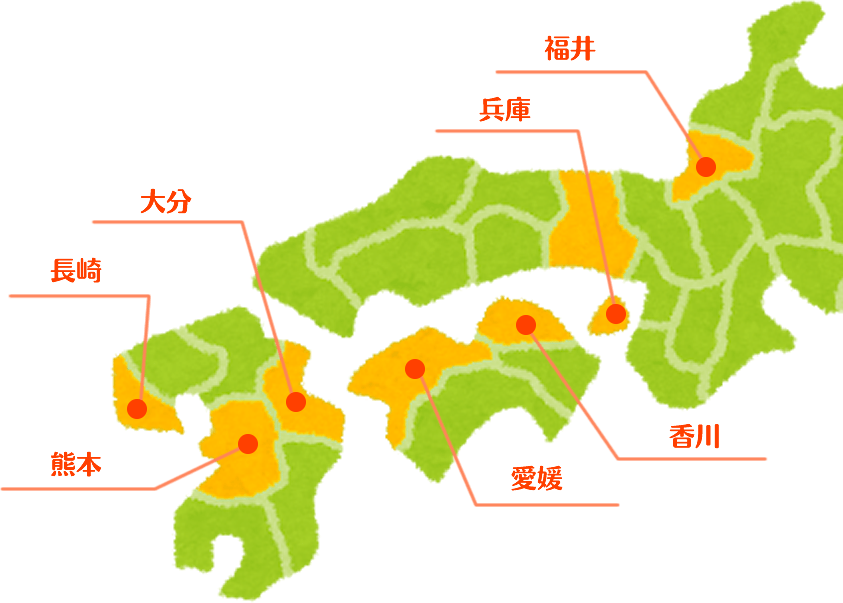
福井県海水養魚協会
Fukui Prefecture Marine Fish Farming Association
兵庫県かん水養魚協会
Hyōgo Prefecture Brackish Water Fish Farming Association
香川県海水魚類養殖漁業協同組合
Kagawa Prefecture Marine Fish Culture Fisheries Cooperative Association
愛媛県魚類養殖協議会
Ehime Prefecture Fish Farming Council
長崎県かん水魚類養殖協議会
Nagasaki Prefecture Brackish Water Fish Culture Fisheries Association
熊本県海水養殖漁業協同組合
Kumamoto Prefecture Marine Aquaculture Cooperative Association
大分県水産養殖協議会
Ōita Prefecture Aquaculture Fisheries Council
